
April 29th, 2026
IAT vs. OAT Coolants: A Technical Procurement Guide for B2B Buyers
The coolant market has two dominant inhibitor technologies, and the difference between them matters significantly in application. Mixing them — or selecting the wrong type for a given engine family — compromises both corrosion protection and service life, often without any visible indication until a component fails.
This guide breaks down what distinguishes IAT from OAT chemistry, how to match product to application, and what procurement teams should look for when sourcing either at volume.
The Chemistry Behind the Classification
Engine coolant is a two-component system: ethylene glycol, which provides freeze and boil-over protection, and an inhibitor package, which provides corrosion, cavitation, and scaling protection. The glycol base is largely equivalent across products. The inhibitor package is where formulations diverge.
IAT — Inorganic Additive Technology
The older of the two technologies, IAT coolants use inorganic compounds — historically including silicates, phosphates, nitrates, and borates — to form a protective film on metal surfaces throughout the cooling circuit. This film-formation mechanism works well and establishes protection quickly, but the inhibitors are consumed over time as they continuously deposit and replenish the film layer.
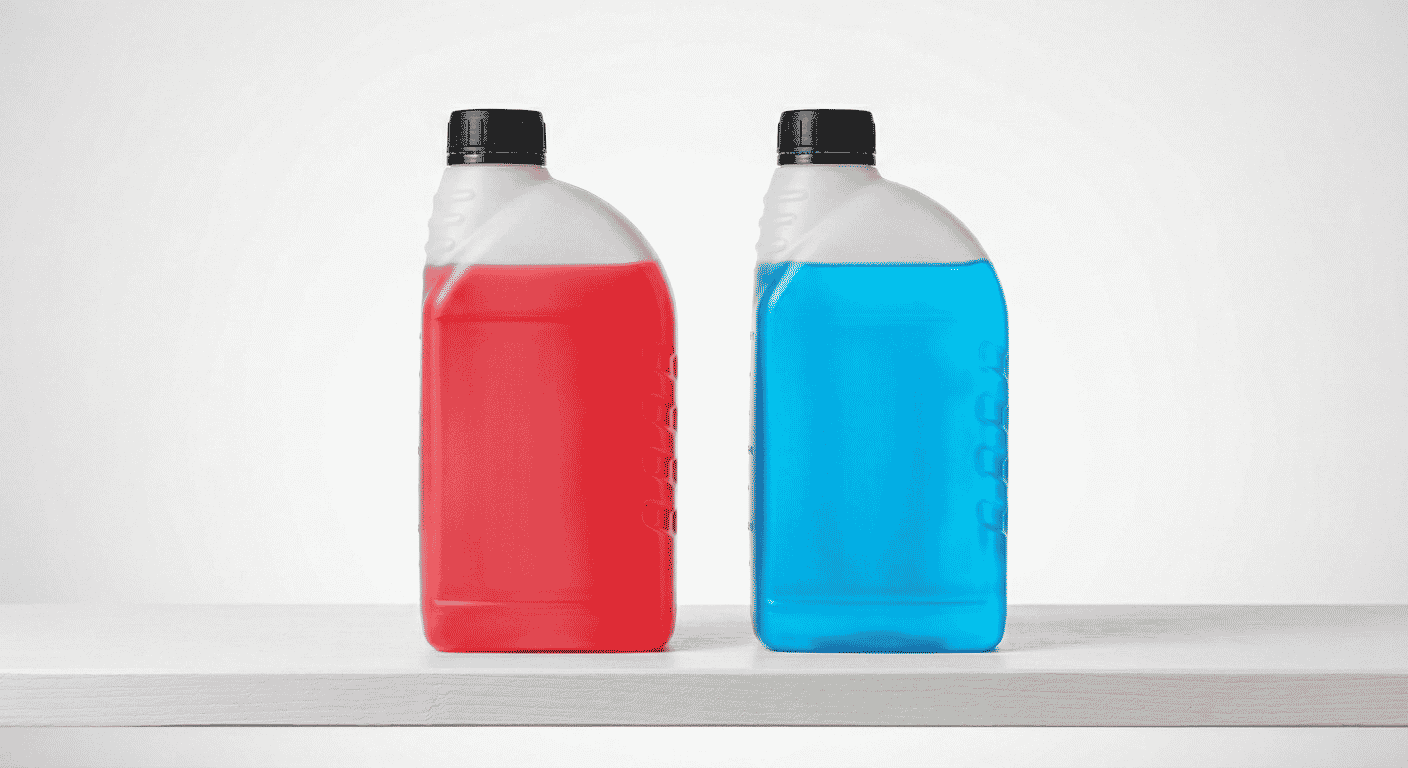
The practical consequence: IAT coolants require replacement every 1–2 years or per the OEM maintenance interval, whichever comes first. They are typically blue in convention, though this is a manufacturer's coloring choice and not an intrinsic property of the chemistry.
IAT formulations remain the correct specification for EURO 1, 2, and 3 engines and for cooling systems built with conventional materials (cast iron, copper, brass components).
OAT — Organic Acid Technology
OAT coolants replace the inorganic inhibitor package with organic acid compounds — primarily carboxylates — supplemented with compatible corrosion inhibitors, pH stabilizers, and cavitation inhibitors. The key difference is in the protection mechanism: OAT inhibitors work through adsorption at metal surfaces rather than bulk film formation. This means the inhibitors are not consumed at the same rate as inorganic ones.
The result is a significantly extended service life — typically 3–4 years — and a reduced tendency to form scale or sludge deposits on heat exchanger surfaces. OAT formulations also tend to be more compatible with the aluminum alloys, magnesium components, and polymer materials used in modern engine designs.
OAT coolants are the correct specification for EURO 4, 5, and 6 engines and are also designated "Long Life Coolant" (LLC) or "Extended Life Coolant" (ELC) in product literature. The conventional color for OAT formulations is red.
Application Matching: Why Cross-Use Is Problematic
A common field error is topping up an OAT-specified system with an IAT product (or vice versa) because the correct type is unavailable. The consequences are not immediate, but they are real:
Mixing IAT silicates into an OAT system degrades the organic inhibitor chemistry and can cause precipitation, reducing inhibitor effectiveness across both chemistries
The service life of a contaminated OAT system defaults toward the shorter IAT interval — at best — or becomes unpredictable
Modern cooling system components designed for OAT chemistry (lighter alloys, elastomers, narrower passages) may not receive adequate protection from IAT inhibitor profiles
OEM guidance is explicit on this point. Where the vehicle or equipment manufacturer specifies OAT coolant, IAT is not a functional substitute — it is a downgrade that may also void warranty coverage on major components.
Dilution Ratios: A Misunderstood Variable
Antifreeze concentrate does not perform best at 100% concentration. Freeze protection follows a curve: it improves as coolant concentration increases up to approximately 60–65%, then worsens at higher concentrations. Pure ethylene glycol freezes at a higher temperature than a properly diluted mixture.
The standard operating recommendation for most climates is a 50/50 mixture by volume — coolant concentrate to distilled or deionized water. This delivers approximately -37°C freeze protection and maintains inhibitor concentration within the effective protective range.
Going below 40% coolant concentration reduces both freeze protection and — more critically — inhibitor concentration to levels where corrosion protection becomes unreliable. Going above 65% reduces freeze protection and provides no additional corrosion benefit.
Pre-diluted products (typically labeled at -37°C or -56°C freeze point) are ready to use and should not be further diluted. Misidentifying a pre-diluted product as concentrate and adding additional water is a common sourcing and handling error that results in an under-inhibited system.
Evaluating Coolant Quality at the Supplier Level
Procurement decisions based on price and freeze point alone create supply chain risk that typically materializes as field failures rather than incoming quality rejections. The parameters that actually determine whether a coolant will protect a cooling system are not visible and not measurable with field instruments.
What performance testing looks like
Reputable manufacturers subject their formulations to aging protocols that simulate extended service conditions. These tests evaluate:
Parameter | Significance |
|---|---|
Corrosion performance (6 metals) | Quantifies actual metal loss across copper, solder, brass, steel, cast iron, and aluminum |
Post-aging pH stability | Indicates whether inhibitor reserves are sufficient to maintain chemistry over service life |
Foaming behavior | Excessive foam causes pump cavitation and localized overheating |
Elastomer compatibility | Quantifies hose and seal dimensional and hardness change |
Post-aging freeze/boil point | Confirms glycol integrity after thermal stress |
A supplier who can provide documented aging test results — not just specification sheets — is demonstrating that the product has been validated, not just formulated. These tests require laboratory infrastructure that not all producers maintain.
Formula consistency matters as much as formula quality
A formulation can pass laboratory validation and still perform inconsistently in the field if production batches are not held to the same standard. The relevant question when qualifying a supplier is not only whether they have test data, but whether the data reflects the product that will actually be shipped. Batch-to-batch consistency — enforced through incoming raw material quality control and in-process testing — is the operational differentiator between a manufacturer and a blender.
Additive sourcing is largely standardized
Unlike engine oils, where OEM-specific additive packages create meaningful proprietary differentiation, coolant inhibitor packages are sourced from a relatively small number of global additive manufacturers. Most serious producers — both global and regional — use inhibitor packages from these suppliers with demonstrated OEM approval histories. This narrows the competitive field to ethylene glycol quality, inhibitor dosage accuracy, and process discipline rather than additive trade secrets.
Summary: Procurement Decision Framework
Factor | IAT | OAT |
|---|---|---|
Engine compatibility | EURO 1–3 | EURO 4–6 |
Service interval | 1–2 years | 3–4 years |
Inhibitor type | Inorganic (silicate/phosphate-based) | Organic acid (carboxylate-based) |
Scale/deposit tendency | Higher | Lower |
Aluminum compatibility | Adequate | Optimized |
Conventional color | Blue | Red |
The correct product selection starts with OEM specification. When sourcing for mixed fleets or multi-equipment operations, the tendency to standardize on a single coolant type should be resisted unless that type is confirmed compatible across the engine families involved.
Alterna Chemicals manufactures and exports both IAT and OAT antifreeze coolant concentrates, including a Heavy Duty OAT formulation for commercial vehicle and off-highway applications. Full TDS and SDS documentation available. Bulk packaging from 20L to 1000L IBC.